Office window film / 20 photos
Offices, La DéfenseVeoliaBearingPointTransaviaLes FuretsScandinavian-style officesAXA OpéraManage transparency with style.
Office window film means applying an adhesive film to the glass partitions, doors and windows of your premises: frosted film for privacy, blackout film to shut out the view completely, lettering or a brand pattern for identity, manifestation bands for safety. Glass partitions are aesthetic but often pose privacy issues. Window film allows creating confidential areas without closing off the space or blocking natural light.
New to window film? Start with our complete guide to window film, or see window film in Paris.What's at stake
Window film meets three essential needs: protecting privacy, making spaces safe and showcasing your identity.
Protect privacy
Create confidential spaces without giving up daylight or the sense of openness.
Make circulation safe
Make glass walls clearly visible to prevent collisions and guide people around.
Assert your identity
Turn glazing into graphic and decorative surfaces, perfectly in tune with your world.
Nos SOLUTIONS
Privacy
Frosted or sandblasted films to opacify meeting rooms while letting light through.
Branding & Identity
Incorporate your logo and values directly onto glass partitions.
Creative Design
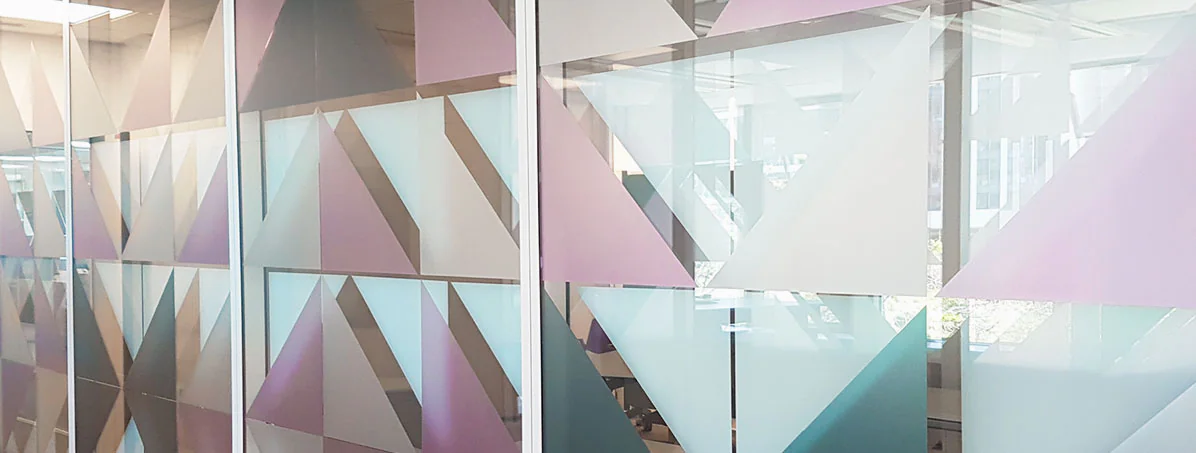
Geometric, organic, or typographic patterns to dress up the space.
A covering made to measure
Measurements
Precise measurement of your glass surfaces.
Pattern Creation
Exclusive pattern design or adaptation of your brand guidelines.
Film Selection
Frosted, sandblasted, colored, dichroic... we have it all.
Digital Cutting
Millimetric precision in our workshops.
Careful Installation
Water or dry application technique, bubble-free.
Projects / Office window film
On site, at our clients
Case studies
32 projects told from brief to installation, across all our clients
- Offices, La Défense
- Veolia
- BearingPoint
- Transavia
- Les Furets
- Scandinavian-style offices
- Art Deco offices
- Les Terrasses de l'Arche
- AXA Opéra
- Ladurée
- BforBank
- AXA Banque
- Jazz New York offices
- Adidas
- Payplug
- AXA, Welcome to the Jungle
- AXA, botanical relief
- Humanis
- EDF
- Cocobeach
- DGGN, reception
- DGGN, cafeteria
- Jo&Joe
- Hôtel Nation
- Montreuil shopping centre
- Arthus-Bertrand
- Story
- Coach, Le Bon Marché
- BNP Paribas Real Estate
- Herno
- SNCF
- Le Petit Prince
Our clients' satisfaction is our greatest pride.
"Merci vous êtes géniaux !!!! Laura tu m'as sauvée la vie :)"
Translated from FrenchThank you, you're brilliant!!!! Laura, you saved my life :)
CCarole L.
Cheffe de projet, Ladurée
"C’est très beau et les collaborateurs sont très satisfaits ! Merci à toute la team Paristic."
Translated from FrenchIt looks beautiful and the staff are very happy! Thanks to the whole Paristic team.
LLaurent S.
AXA France
"Je travaille avec vous depuis plusieurs années, je ne peux pas changer de prestataire :)"
Translated from FrenchI've been working with you for several years, I can't change supplier :)
AAxel
Happy Manager, AXA Banque
"Je n’ai plus l’impression de travailler dans un aquarium ! Et c’est super élégant."
Translated from FrenchI no longer feel like I'm working in a fishbowl! And it looks really elegant.
JJean-Luc
Stamina
"Je ne reçois que des compliments sur le travail réalisé."
Translated from FrenchI get nothing but compliments on the work.
AAnna
Merchandiser, Ladurée
"Merci à Laura pour sa réactivité sur chacune de mes demandes."
Translated from FrenchThanks to Laura for her responsiveness on every one of my requests.
MMarie-Claire
Veolia Paris
Our Strengths
Why choose us?
Expertise
A dedicated team.
Quality
Premium materials.
Speed
Deadlines respected.
Our COMMITMENTS
What you can count on, project after project.
20 years of experience
Design, production and installation of bespoke decors.
1,200+ projects delivered
Offices, shops, hotels and restaurants.
Eco-Responsible
Solvent-free inks and waste recycling.
Project Tracking
A single contact from quote to installation.
A dedicated team, from art direction to installation.
Premium materials, proof approved by you before production.
Deadlines respected, installation scheduled with you.
Clean installation
No heavy building work, site left clean.
Films for glass partitions, and what each one solves
In an office, the problem is almost never aesthetic to begin with. It is human. People work behind glass, feel watched, lower their voices in meetings, or end up taping brown paper to the partition. Adhesive film solves this cleanly, and each material addresses a specific discomfort.
Frosted and etched-glass film
The etched-glass effect in adhesive form. You can no longer see through, but the light still gets in. It is what we install in the vast majority of meeting rooms and executive offices. For the same surface area, a floor treated with frosted film stays as bright as before, which is never the case with a blind.
Gradient and pixelated film
Opaque that turns transparent as it rises. It screens exactly the seated eye level, so screens and documents on desks, while keeping the feeling of open space above. It is the best compromise in open-plan offices, because it provides privacy without visually re-partitioning the floor.
Blackout and opaque film
For surfaces that need to be closed off completely: HR office, boardroom, privacy room, IT storeroom. The film is total, the partition becomes a wall, and becomes glass again the day the room's use changes.
Cut lettering and brand patterns
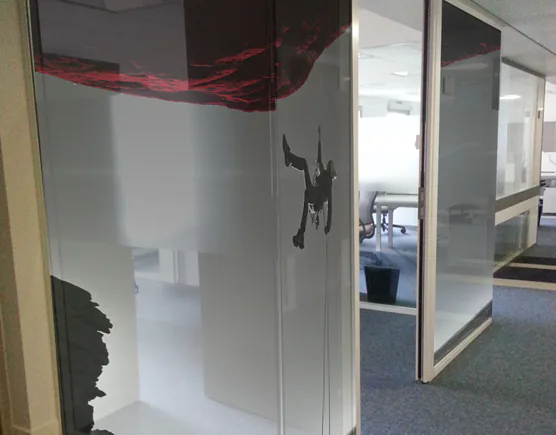
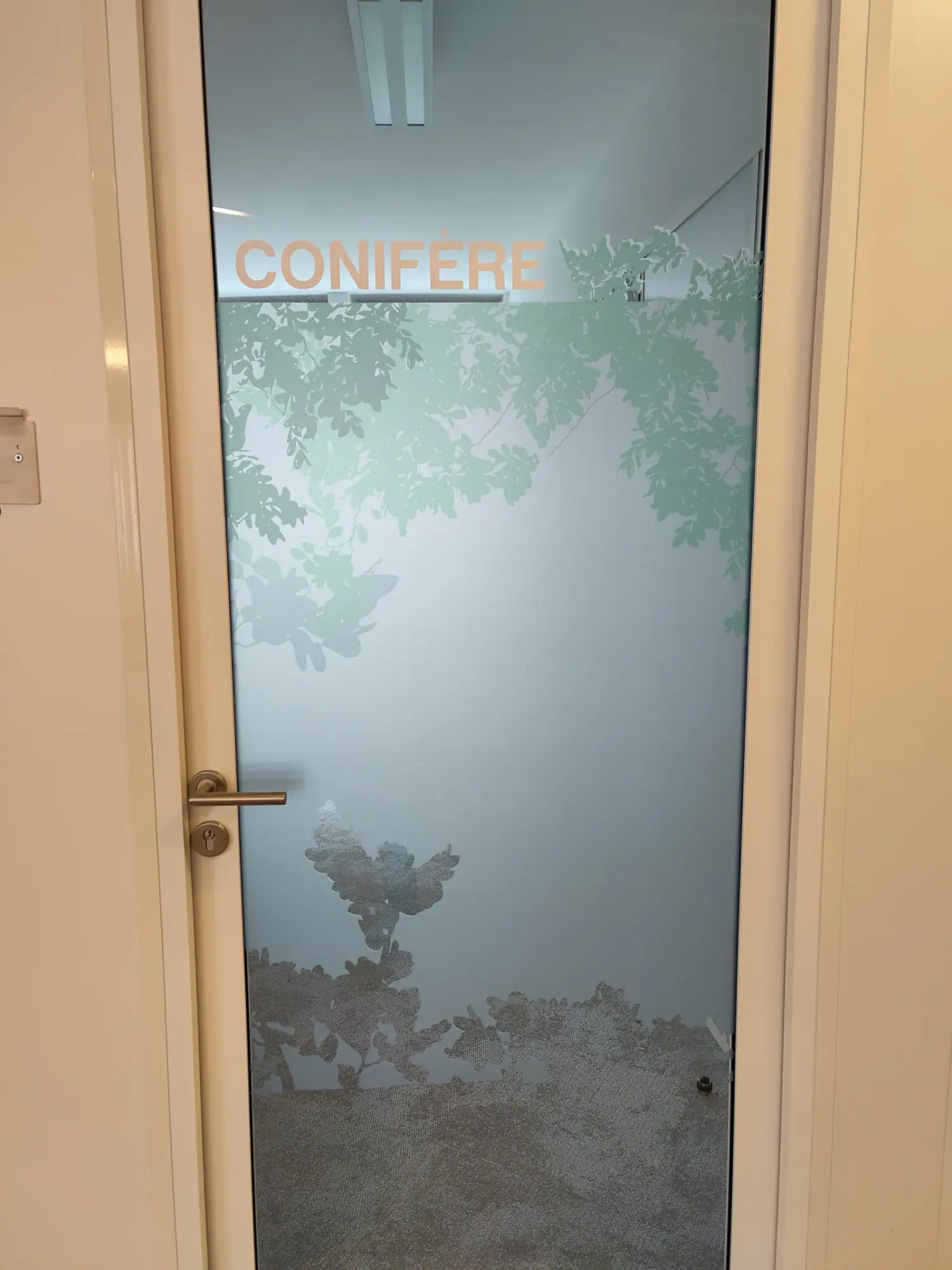
Room numbers, space names, pictograms, floor signage and, above all, your brand pattern. This is where the constraint becomes an asset: the film that stops people seeing in carries your visual identity, and your floors stop looking like every other office floor.
Static cling and repositionable film
With no adhesive, held by simple cling, it can be removed and reapplied without leaving a mark. Useful in rented premises where the lease forbids any alteration, or for signage that changes often, such as room booking.
Personalising your glass partitions: bringing your identity into the office
Office window film isn't only for hiding things. On a modern office floor, glass partitions represent dozens of square metres of neutral surface: the largest brand medium available in your premises, and usually unused. A pattern derived from your logo as a frieze at seated eye level, a brand colour in a gradient on meeting rooms, each room's name in cut lettering, a values statement on the reception glass: the partition goes from technical constraint to decorative feature.
It is also a lever for the working atmosphere. An open-plan office where each room has its own pattern is easier to read and to remember (“see you in the wave room”), and gives teams the feeling of a place designed for them rather than rented by the square metre. Companies that recruit know this: the office tour is part of the interview.
Decorative film combines with privacy film: same installation, same material, one job. It is coordinated with the 3D logo in reception, the room signage and the wall decoration, so that the space speaks with one voice. And the day your identity evolves, the film comes off and is replaced without touching the glass.
Marking glazed walls: accessibility rules
It is the most misunderstood subject in the whole trade, and the one that comes up most often in offices, because a modern office floor is full of transparent partitions crossed by circulation routes.
The rule: in a building open to the public, a glazed wall located on or alongside a circulation route must be made visible with visual markings that contrast with their immediate surroundings, and these markings must be visible from both sides of the glass. The aim is simple: nobody should mistake the glass for a way through.
The two bands are not mandatory
The 5 cm bands placed at 1.10 m and 1.60 m from the floor come from a 2006 French circular. They have become the de facto reference, and you will often be sold them as the only compliant option. The text itself talks about visibility, contrast and markings seen from both sides. It imposes no shape.
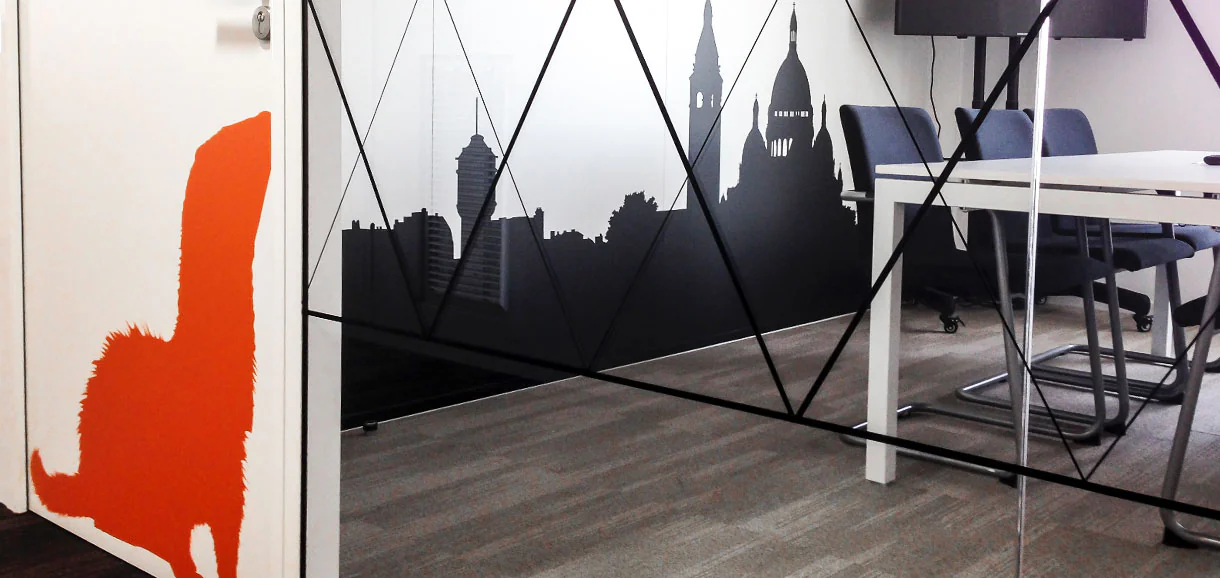
In practice, a frieze, a repeated pattern or a graphic band taken from your brand guidelines performs exactly the same function, as long as it contrasts sufficiently and can be seen from both sides. Your accessibility compliance stops being a pair of grey strips stuck on brand-new partitions. It becomes part of the design of your spaces.
What we check before we design
What is behind each glazed wall, because contrast is judged against what you see through the glass, not in the abstract. The actual layout of circulation routes, to know which partitions are concerned. And the result under artificial lighting, because a light-coloured pattern that is perfectly legible in daylight can disappear in the evening, when interior lighting reverses the contrasts.
What office window film costs
Pricing is per square metre installed. Four factors determine it: the total surface area, the type of film, the complexity of the cutting and the installation conditions.
In offices, it is often the last point that makes the difference. A partition accessible at floor level, a raised glass roof that needs a cherry picker, an occupied floor where work has to be done outside office hours: for the same surface area, these are not the same jobs. A roll-out across several floors or sites also changes the calculation, downwards this time, because preparation time is shared.
We quote after a site survey. It is the only way to give a price that holds right through to the invoice.
By type of premises
Open-plan offices
Gradient at seated eye level, frosted phone booths, glazing markings along circulation routes. You gain privacy without losing a single lux.
Medical and healthcare practices
Patient confidentiality at reception, screening of treatment areas, marking of glass doors. Strict obligations that can still look elegant.
Law firms and notaries
Confidential meeting rooms, partners' offices, understated signage. Here the film has to say serious before it says modern.
Lobbies and reception areas
A logo at the scale of the glazed wall, floor numbers, glass door markings, dressing of entrance airlocks. A visitor's first five seconds are decided here.
Meeting room window film: setting the level of privacy
Meeting rooms account for most requests. The level of opacity needed depends on what is said in the room, and a fully opaque partition would lose what justified the glass in the first place: light and a sense of space. We think in three levels, often combined on the same floor.
Project rooms and everyday meetings
A frosted band or a gradient at seated eye level. You can see the room is in use, but you can no longer read screens or documents on the table. The top of the partition stays clear and the room keeps its light.
Management, HR, interviews
Full-height frosted film, sometimes with blackout film on the door or the lower section. Frosted film blurs the view but silhouettes can still be made out, especially in the evening when the room is lit and the corridor is dark: that is the point to check before choosing.
Phone booths and focus pods
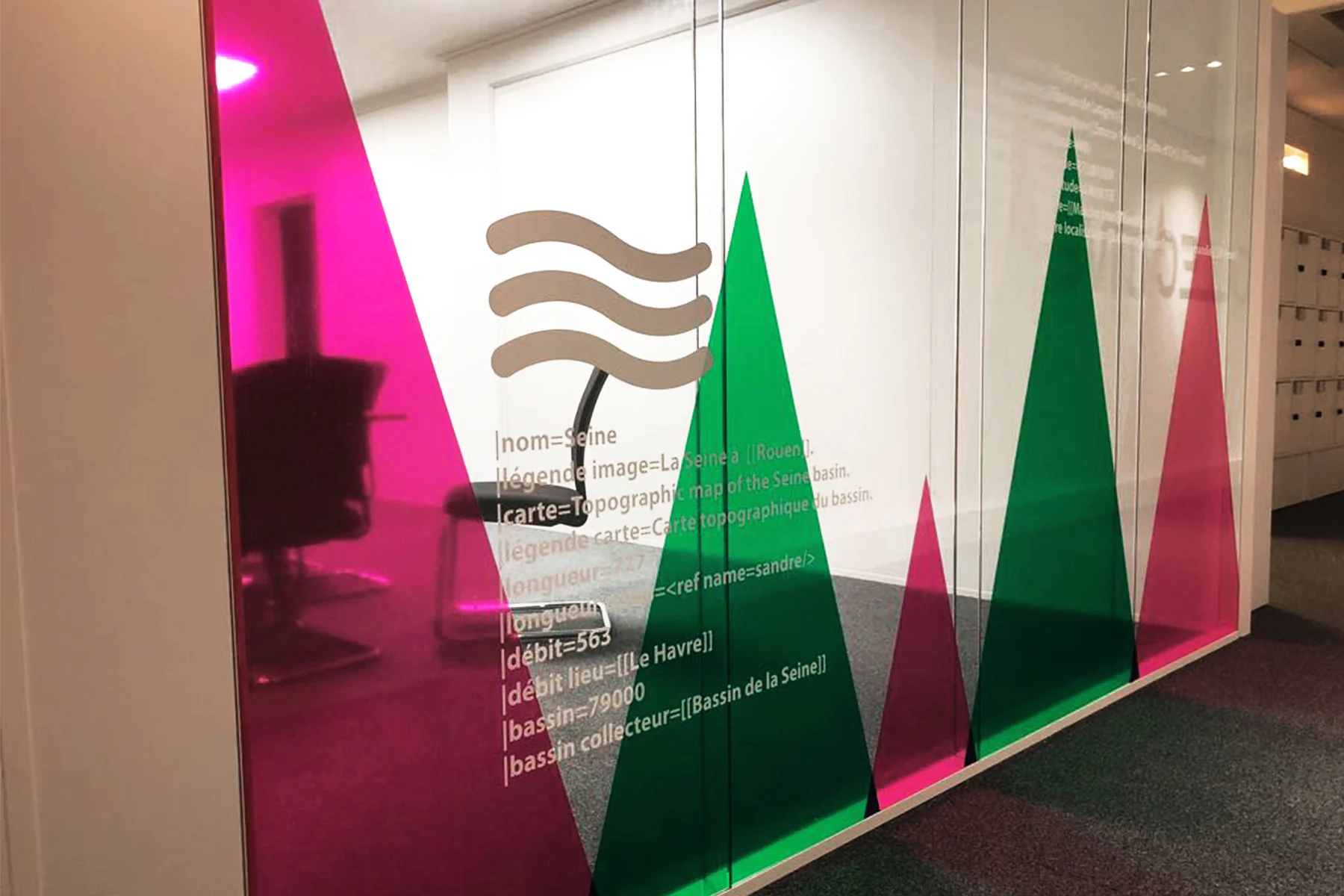
A pattern cut into the frosted film, with the name of the space built into the design. At Veolia, the density of a water-drop pattern follows the privacy level of each room: the more sensitive the room, the tighter the pattern.
Blackout film or frosted film for an office?
Frosted film, with its etched-glass effect, diffuses light and blurs the view: it is a privacy film, not a blackout film. Blackout film is opaque: it blocks both view and light, and the partition becomes a wall. In between, gradients, cut patterns and tinted films let you fine-tune the balance between privacy and brightness.
For an office window exposed to the sun or overlooked from the street, the question is different. Reflective one-way film gives privacy in daytime, when the outside is brighter than the inside, and reverses in the evening. If the problem is heat or glare, what you need is solar film, not decorative window film.
How office window film is installed
Most office films are applied wet. Avery Dennison's data sheet for its Etched Glass Window Film (November 2024) recommends this wet method, with water containing 0.5% neutral detergent, a firm squeegee, and an application temperature of at least 10 °C. The same data sheet states a durability of 15 years indoors and 7 years outdoors, in vertical exposure and central European conditions.
On site, that means five steps: clean and degrease the glass and seals, wet the surface, position the film, push water and air out from the centre to the edges, and trim the film along the glazing beads. Cut lettering and patterns go on with transfer tape, removed once the adhesive has taken. The full detail is on our window film installation page.
Office window film: our projects
Transavia
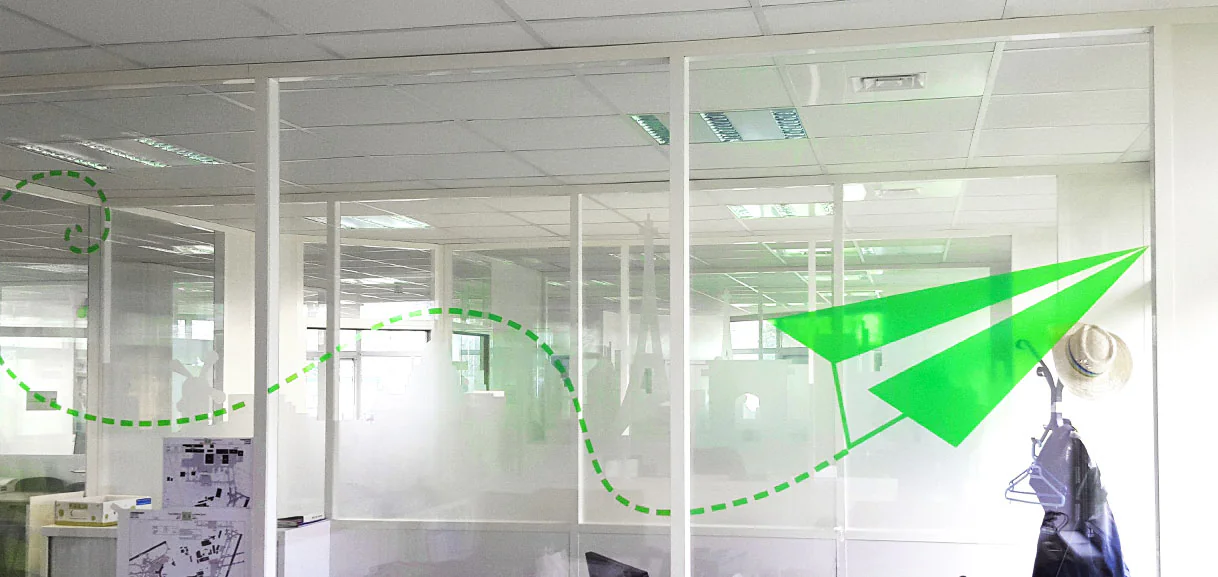
Travel-themed window film, city maps and European skylines, with Dibond signage true to the airline's brand guidelines.
Veolia
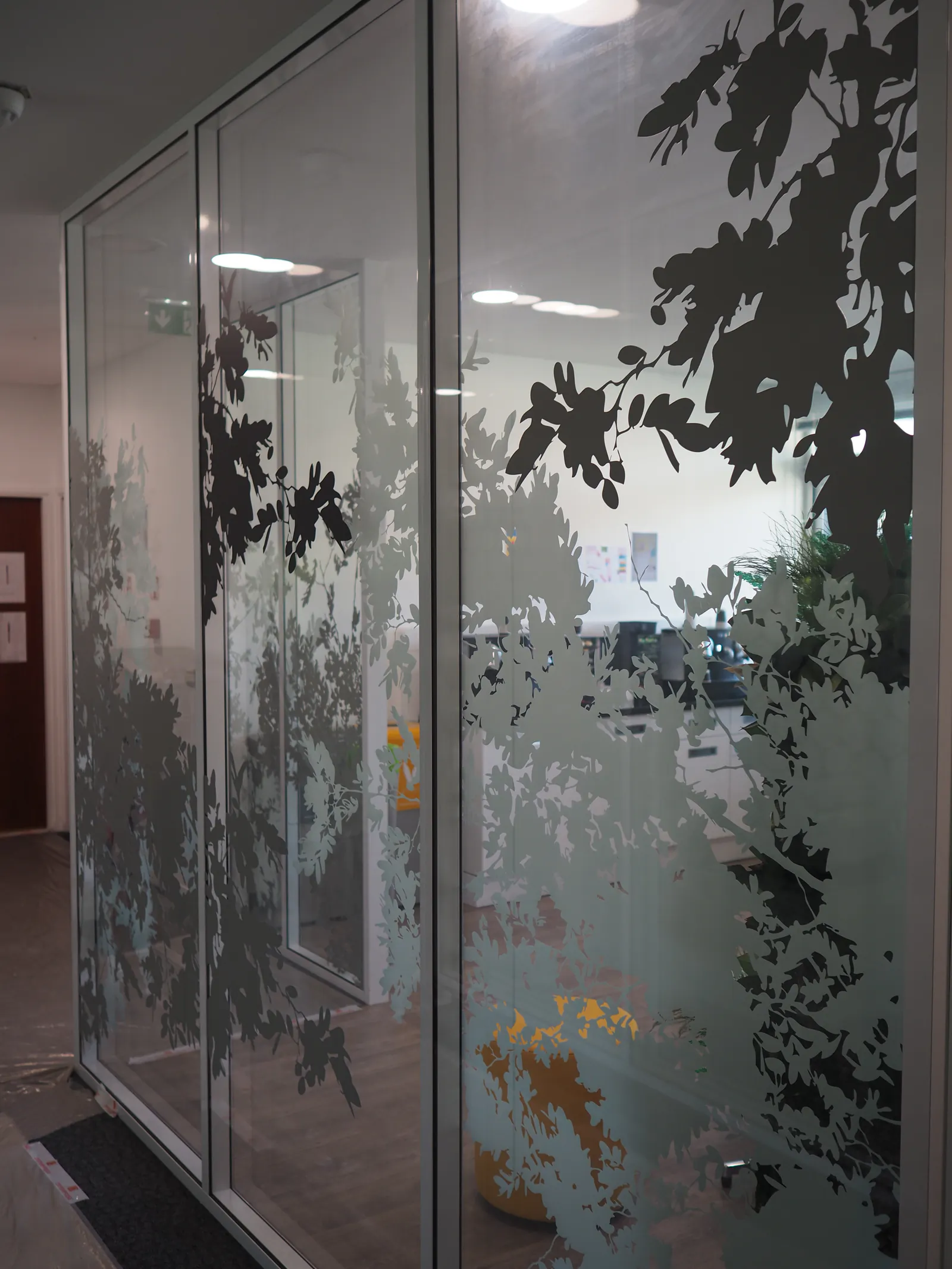
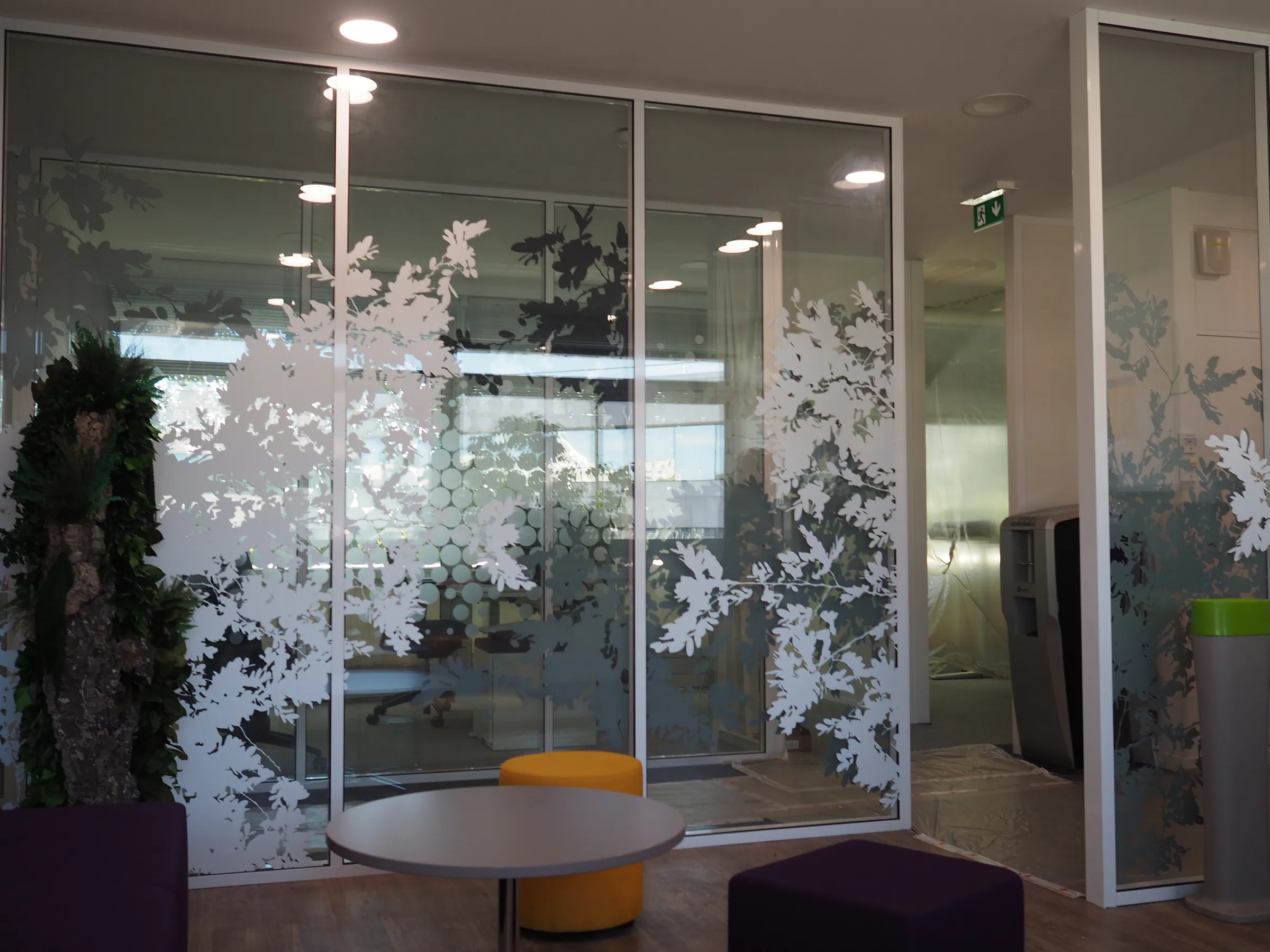
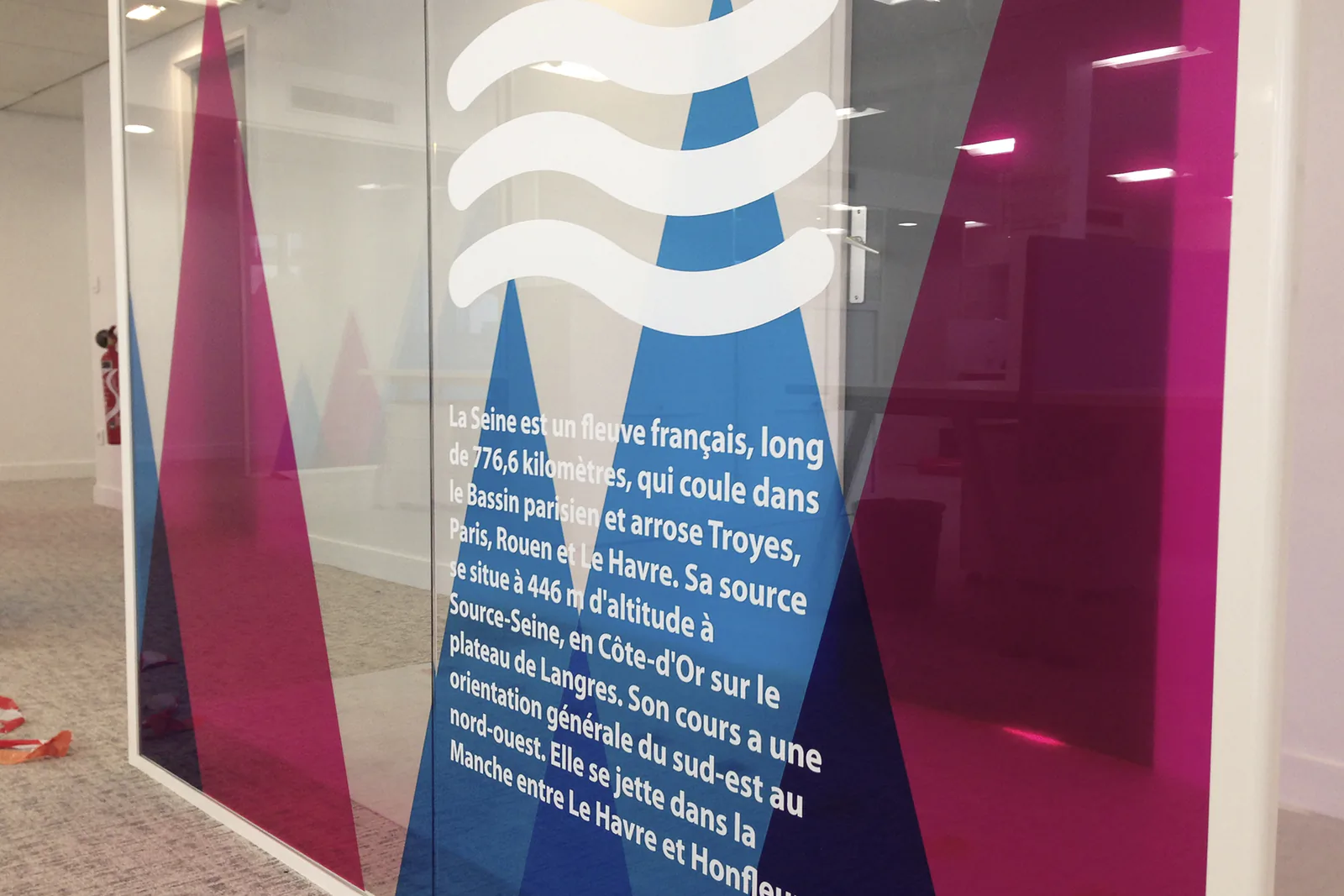
A water-drop pattern whose density follows the privacy of each room, floor signage and a trompe-l'œil forest film.
Insurance company, La Défense
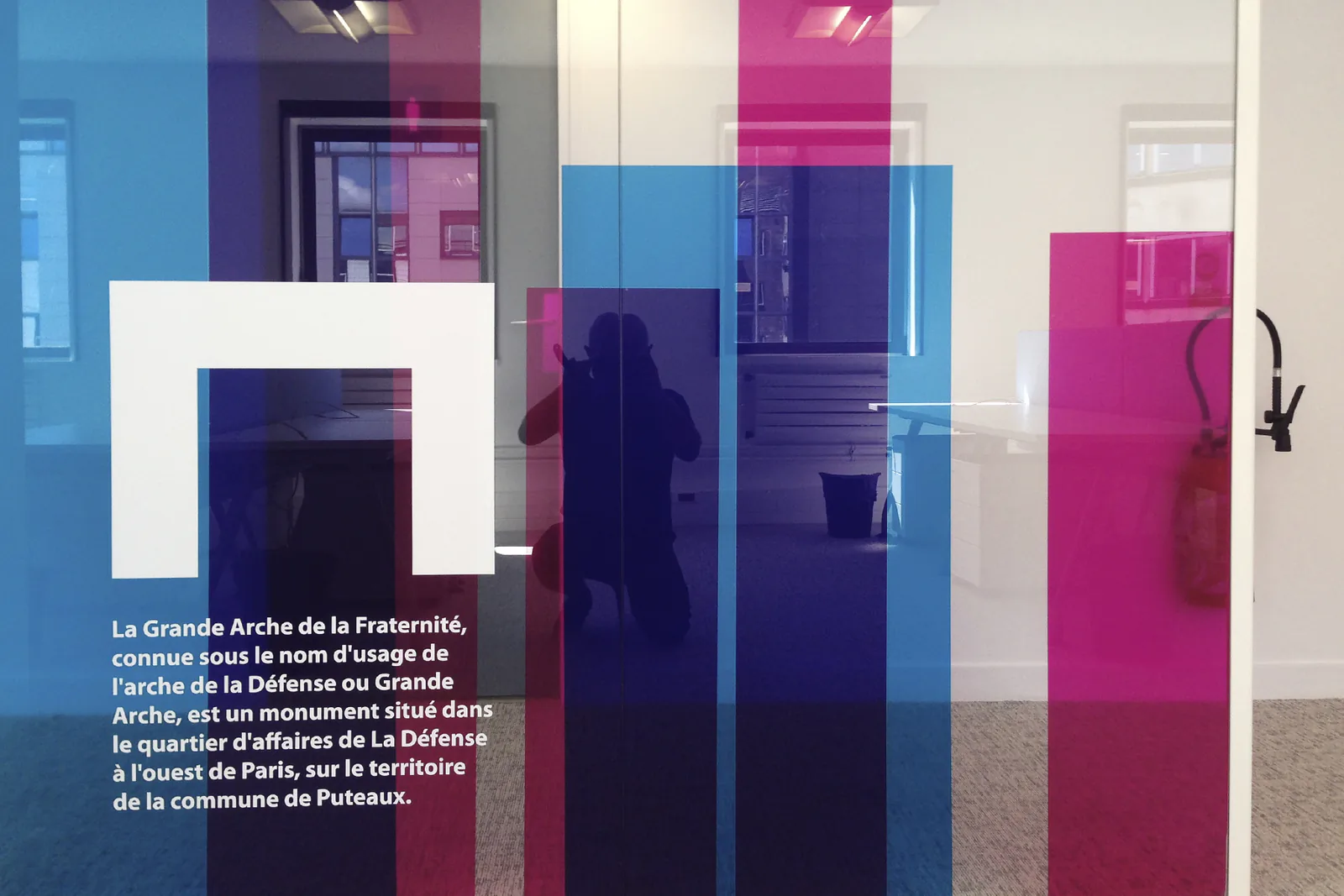
Four floors, three layered films and one colour code per floor: wayfinding by colour and by shape.
BearingPoint
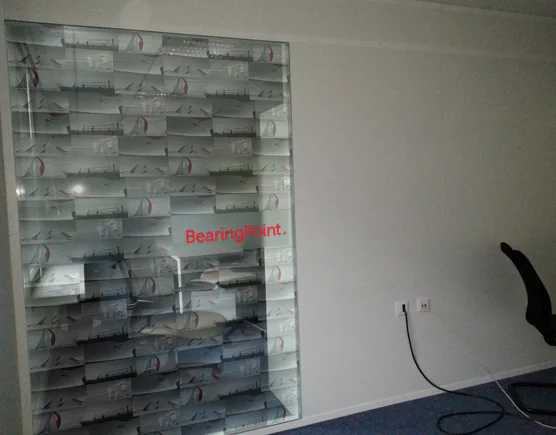
Over 800 m² of wall graphics, whiteboard walls, window film and signage, designed around the firm's values.
Les Terrasses de l'Arche
Several hundred square metres of glazing and walls dressed over several floors, extending an existing scheme.
Continue exploring
Related services and resources: solar window film, window film installation, office layout and decoration, office signage, bespoke wall decoration, office window film in Paris, complete guide to office window film, window film fitters in Paris, case study: window film design in La Défense, case study: Veolia zen window film, case study: BearingPoint window film and whiteboards and case study: Transavia travel window film.
Frequently Asked Questions
What are the accessibility rules for marking glazed partitions?
In a building open to the public, glazed walls located along a circulation route must be made visible with visual markings that contrast with their immediate surroundings and can be seen from both sides of the glass. The 5 cm bands at 1.10 m and 1.60 m come from a 2006 French circular: they are one solution, not a mandatory format. A pattern taken from your brand guidelines is compliant as long as it contrasts sufficiently and can be seen from both sides.
What is the average price of window film?
There is no reliable average price, because two jobs of the same size can have nothing in common. Pricing is per square metre installed and depends on the total surface area, the type of film, the complexity of the cutting and the installation conditions. A partition accessible at floor level and a raised glass roof are not the same job, even for the same surface area. On the other hand, a roll-out across several floors or sites brings the unit cost down. We quote after a site survey.
How do I keep the light while gaining privacy?
That is exactly what frosted or gradient film does. Unlike a blind or a solid partition, it blocks the view without blocking the light: a treated floor stays as bright as before. A gradient at seated eye level is the most common setting in open-plan offices, because it hides screens and documents while leaving the space open above.
Does installation disrupt teams' work?
No, because in the vast majority of cases we work outside office hours: early in the morning, in the evening or at weekends. A meeting room takes a few hours. On a full floor, we split the job into zones so that no workstation is out of action for more than half a day.
How do you install window film?
The glass is cleaned and degreased, wetted with slightly soapy water, the film is positioned, then water and air are pushed out with a squeegee from the centre to the edges before the film is trimmed along the seals. Avery Dennison's data sheet for its etched glass film (November 2024) recommends this wet method, with 0.5% neutral detergent, and an application temperature of at least 10 °C. Cut lettering is applied with transfer tape.
Which blackout film should I choose for an office?
An opaque blackout film, in white, black or one of your brand colours, when the view must be shut out completely: HR office, boardroom, storeroom. If light still needs to come through, full-height frosted film is enough in most rooms. For a street-facing window with people opposite, reflective film gives daytime privacy but reverses in the evening, when the inside is brighter than the outside.
Which film gives privacy without losing light?
Frosted film (etched-glass effect) is the benchmark. It diffuses light instead of stopping it and blurs the view from both sides of the partition. Silhouettes can still be made out, especially when the room is lit and the corridor is dark: for complete privacy, you move to blackout film on all or part of the glass.
Can the patterns be customised?
Yes, we create bespoke patterns (lines, dots, organic shapes) or incorporate your logo. It is an excellent way to strengthen your office branding.
How long does window film last?
Outdoors, allow 3 to 7 years depending on the film range, exposure and maintenance. Indoors, it lasts longer: the films don't yellow or peel.
Is installation noisy or messy?
No, window film installation is clean and quiet. We can work during your office hours without disturbing your staff.
Do you also provide signage?
Yes, we can build room names or numbers directly into the design, or add raised signage on doors.
Free ResourceFree Guide
Discover our advice and practical tips to transform your space.
Get your free quote
Tell us about your project, we'll get back to you.