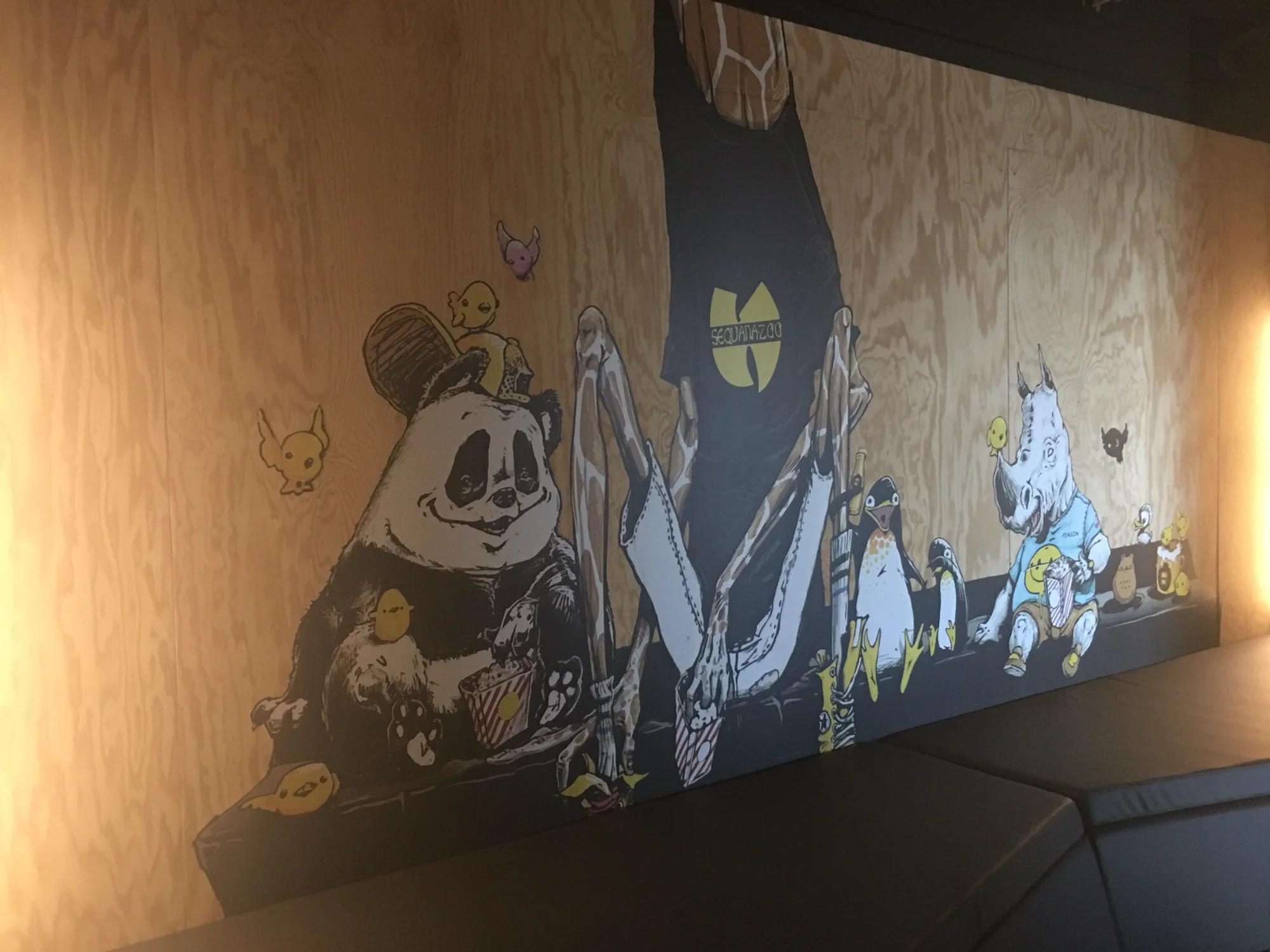
Restaurant and hotel decoration, the Paristic way
Paristic is a space design agency: we design, make in our workshop and install the decor of restaurants, bars, cafés, hotels and staff restaurants. One team runs the project, from art direction to the last installation, in Paris, across Île-de-France and throughout France.
Since 2006, more than 1,200 fit-out and decoration projects: hotel rooms updated through the walls alone, the show floor of a new hotel concept, a hotel reception turned into a metro platform, a cafeteria covered with photographs of Paris. We do not sell decorative objects from a catalogue: we create the world of the venue and make it real.
A venue's decor works as a whole: wall decoration, a painted mural, a 3D logo in wood, metal or moss, window graphics on the bays and signage on every floor. For one-off events, see our event decoration.
Hotels and restaurants / 17 photos
Hôtel NationJo&JoeDGGN, receptionDGGN, cafeteriaWhat restaurant and hotel decor has to withstand
There is no shortage of decoration ideas. What is often missing is decor that holds up in a working venue: service, daily cleaning, guests every night and the safety commission's visit.
An identity people recognise
Restaurants and hotels are increasingly chosen from a photo. The decor has to project a clear image, consistent with the name, the menu and the target guests, carried from the frontage to the corridors.
Materials that last
Chair knocks, housekeeping trolleys, kitchen steam, cleaning products: every surface and material is chosen for how the room is really used, not only for how it looks on day one.
Works that do not close you
Every day closed costs revenue. Installation is organised zone by zone, outside service hours, at night or room by room.
Rules to comply with
Restaurants and hotels receive the public, so their decor falls under the French fire safety rules for public buildings (ERP). Better to account for them when choosing materials than at the safety inspection.
Four hospitality projects, told in full
Hôtel Nation, Paris
Updating the rooms through the walls alone
The hotel wanted to attract a younger clientele and show its rooms better on booking platforms, without changing the furniture. Our studio reworked the Parisian style with an offbeat twist. The artwork was printed on a reinforced-adhesive film, essential on a honeycomb textured wall covering, then installed quickly so as not to disturb guests.
Read the case studyJo&Joe, groupe Accor
The show floor of a new hotel concept
For the launch of Jo&Joe, a show floor decorated with graffiti artist Nilko: a logo in milled spruce filled with preserved lichen in our workshop, artworks printed on large-format acrylic, and reinforced-adhesive film able to hold on raw, untreated wood. Every material was chosen for its surface.
Read the case studyDGGN, hôtel
A hotel reception turned into a metro platform
The metro tiling was photographed and reproduced at full scale on printed film, installed across every wall of the reception. A photographic triptych printed on Dibond completes the scene, and the floor signage follows the drawing of a metro line whose stations are replaced by room numbers. A project carried out in collaboration with the RATP.
Read the case studyDGGN, cafétéria
A cafeteria designed as a walk through Paris
Walls more than 15 linear metres long covered in one piece with photographs of Paris shot for the project, a bar illustrated in film cut motif by motif, and Morris columns in chalkboard film on which the team writes the menu of the day.
Read the case studyMore projects in our case studies and our portfolio.
Decoration techniques for restaurants and hotels
Wall graphics and bespoke wallpaper
An image created for your wall, printed large format on film or non-woven wallpaper, then installed by our teams. It is the fastest way to change a dining room or a bedroom, even on a textured wall with the right adhesive.
Learn more: Wall graphics and bespoke wallpaperPainted mural or street art
A mural painted by hand or with spray paint turns one wall into the signature of the venue, the one guests photograph. The design is framed and approved with you before it is painted on site.
Learn more: Painted mural or street artPreserved moss and plants
Preserved moss, lichen and foliage create a green decor that needs neither watering nor daylight, as a wall, a logo or lettering. Like any fixed or hanging decor, it is chosen with its fire rating in mind.
Learn more: Preserved moss and plants3D logo and raised lettering
A logo at reception, the restaurant name above the bar, backlit lettering: wood, metal, acrylic or moss, made in our workshop and installed at the right height and under the right light.
Learn more: 3D logo and raised letteringWindow graphics for shopfronts and bays
Film on glass: name and opening hours on the shopfront, reproductions of paintings on the bays as at the DGGN hotel, frosted film to keep a dining room private from the street.
Learn more: Window graphics for shopfronts and baysFloor and room signage
Room numbers, floor plans, restrooms, meeting rooms: signage that is part of the decor instead of being added on top.
Learn more: Floor and room signageCounters, furniture wraps and artworks
Bar counter, cabins, doors, columns: the right film covers an existing surface without replacing it. Artworks printed on acrylic or Dibond punctuate corridors and bedrooms.
Learn more: Counters, furniture wraps and artworksWhere we work in a restaurant or hotel
Dining room
Feature wall, banquettes, screens between tables, ceiling: the atmosphere is built around where the guest sits.
Bar and counter
The counter draws the eye: wrap of the bar front, lettering, the name of the venue put forward.
Frontage and shopfront
The first impression is made from the pavement: window graphics, lettering, a seasonal display that makes people want to come in.
Hotel lobby and reception
The first decor the traveller sees, and often the first published photo of the property.
Bedrooms
Headboard wall, the wall facing the bed, ceiling: a complete change of style without changing the furniture.
Corridors, landings, stairs
Long, often forgotten surfaces that can carry a common thread from floor to floor.
Staff restaurant and cafeteria
A break room people want to stay in, with surfaces that are useful every day, like chalkboard film for the menu of the day.
Decor and fire safety: what the French ERP rules say
A restaurant, bar or hotel is a building open to the public (ERP). Restaurants and bars are type N, hotels and other accommodation type O [1]. Their decor is governed by the chapter on interior fittings, decoration and furniture of the safety regulations approved by the decree of 25 June 1980. Here is what the articles say, without shortcuts, and what they allow.
At Paristic, fire rating is part of choosing every material, just like appearance and maintenance. Ask us for the classification reports of the products selected: they answer the safety officer's question before it is asked.
Sources (Légifrance, checked on 29 September 2026)
- [1] Decree of 25 June 1980, French fire and panic safety regulations for public buildings (ERP), article GN 1 (type N: restaurants and bars; type O: hotels and other accommodation). Légifrance
- [2] Same decree, article AM 4, version in force since 2 January 2010. Légifrance
- [3] Same decree, article AM 9, version in force since 2 January 2010. Légifrance
- [4] Same decree, article AM 10, version in force since 1 January 2010. Légifrance
- [5] Same decree, articles AM 11 and AM 12. Légifrance
- [6] Same decree, article AM 19, paragraph 6. Légifrance
- [7] Decree of 21 November 2002 on the reaction to fire of construction and fitting products, annex 4. Légifrance
- [8] Decree of 19 February 2026 amending the decree of 25 June 1980, applicable to applications filed from 1 June 2027. Légifrance
How a restaurant or hotel decoration project runs
Site visit and survey
We visit the venue while it operates: circulation, surfaces, light, access, service hours, type of public building.
Art direction
Our art directors propose a world consistent with your name, your menu and your guests, developed room by room.
Visuals in context
You see the decor on photos of your own dining room or bedrooms before anything is made.
Choice of materials
Durability, cleaning, appearance under your lighting and fire rating: each material is chosen for how the room is used.
Workshop production
Large-format printing, cutting, laser engraving, mounting: the pieces leave our workshop checked before installation.
Off-hours installation
Installation zone by zone, outside opening hours, at night or room by room, with the site protected and left clean.
What sets the price of restaurant or hotel decor
Every decor is created for its venue, so its price is calculated on the real project. Six factors set it. We prepare an itemised quote after visiting the venue.
Request a quoteContinue exploring
Related services and resources: bespoke wall decoration, painted and street art murals, 3D logo and raised lettering, floor and room signage, bespoke event decoration, free wall decoration guide, case study: Hôtel Nation rooms, case study: Jo&Joe show floor, case study: metro-platform hotel reception and case study: Paris-themed cafeteria.
Frequently Asked Questions
What are some decoration ideas for a restaurant?
The ideas that work best in restaurants give the venue an identity: a feature wall with a painted mural or bespoke wallpaper, the name of the restaurant in backlit raised lettering above the bar, a preserved moss wall or logo, a wrapped bar counter, window graphics that draw people in from the street, and chalkboard film for the menu of the day. Paristic designs these decors, makes them in its workshop and installs them outside service hours.
What are the different types of restaurant and hotel decoration?
There is wall decoration (printed film, bespoke wallpaper, painted murals), raised elements (logos, lettering, panels), green decor (preserved moss), decoration on glass (window graphics), signage built into the decor, and wraps for existing furniture (counters, doors, cabins). In a building open to the public, each one has its own fire rating requirements.
What regulations apply to fitting out a restaurant in France?
A restaurant is a type N public building (ERP), subject to the fire safety regulations approved by the decree of 25 June 1980. For decoration: walls must be C-s3, d0 or M2 (article AM 4), raised decor must be too once it covers more than 20% of the walls (article AM 9), and hanging decor in a room larger than 50 m² must be M1 (article AM 10). Accessibility, hygiene and planning are covered by other texts.
What is the best colour for a hotel bedroom?
There is no single ideal colour: the right one matches the positioning of the hotel and looks good under its real lighting and in photos. A calm base on most walls with one feature wall behind or facing the bed works in most rooms. We always approve colours on in-context visuals before production.
What are the decoration trends for hotels and restaurants?
In our hospitality projects three directions come back: artists stepping in (street art, graffiti, murals), preserved moss, which brings nature without maintenance, and decors that tell the story of a place, like the hotel reception turned into a Paris metro platform. A trend is only worth following if it serves the identity of the venue.
Do we have to close during installation?
Rarely. Installation is planned with you: zone by zone, outside opening hours, at night, or room by room in a hotel. Film-based decor and elements prefabricated in the workshop are the quickest to install on site.
How much does restaurant or hotel decoration cost?
The price depends on the surface treated, the techniques (film, wallpaper, mural, relief, moss), the design work (studio, photo shoot, artist), the fire ratings required, access and installation schedule, and the number of venues. Paristic prepares an itemised quote after visiting the venue.
Do you work outside Paris?
Yes. Paristic is based in Paris and works across the Île-de-France region and throughout France, for a single venue or a network of addresses. Since 2006 the agency has delivered more than 1,200 fit-out and decoration projects.
Get your free quote
Tell us about your project, we'll get back to you.